AI Agent vs Chatbot – Which Is Better for Business? Complete 2026 Comparison Guide
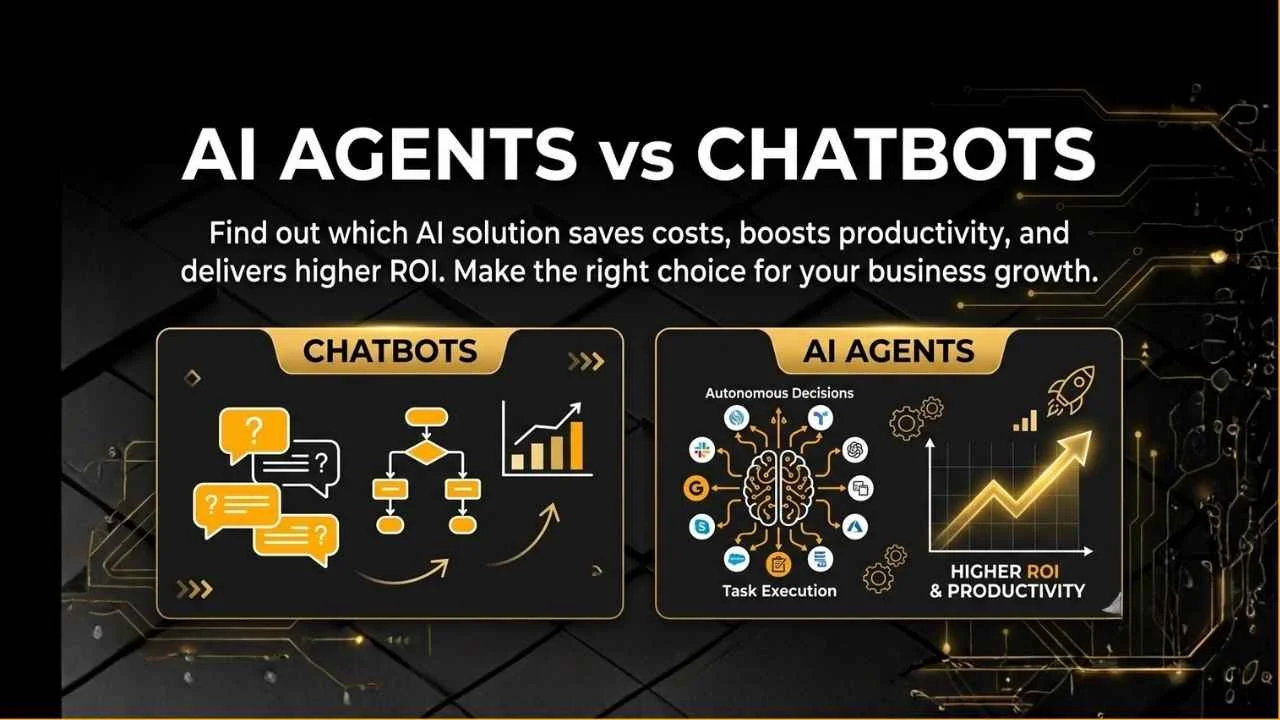
We are currently shifting from the era of Chatbots to the era of AI Agents. The difference is going to be massive, as Chatbot gives you textual outputs and the AI agents can actually take an action. There is a lot of confusion about which will be more cost-friendly and ROI for the business. While Chatbots have dominated the first wave of With LLM adoption, the industry is pivoting towards AI agents. A chatbot is essentially a conversational interface that gives answers to users and performs simple tasks.
Chatbots are like ChatGPT, Geminie, etc., where you enter the prompt and in response, they give you content. In comparison, the AI agents can work on your behalf, integrating with CRM, ERP, and cloud tools. They automate operations, reduce errors, schedule tasks, and generate reports into a fully independent digital workforce.
The AI Agent vs Chatbot depends on business needs; Chatbot gives low-cost support while AI agents generate higher ROI. This guide explains which works best for your unique needs, learn the difference, special features, cost comparison, and growth potential.
Example: ChatGPT as a popular chatbot (source: chatgpt.com)
What Is a Chatbot? (Simple Business Explanation)
A chatbot is computer code that mimics human dialogue, either in written or spoken form. A chatbot is a virtual assistant in a business setting that will respond to customers on websites, WhatsApp, Facebook Messenger, apps, or live chats. It is among the most prevalent types of conversational AI used in contemporary businesses.
How a Chatbot Works: Chatbot works based on predefined rules or artificial intelligence models. Upon inputting a query, the chatbot analyzes the input and compares it to an existing programmed response or applies AI to create a response. It operates 24 hrs and is capable of multitasking so it is handy for customer-facing jobs.
1. Rule-Based Chatbots
These are set paths of decisions. They react to keywords and pre-written scripts. When a question is not covered by programmed rules, they are unable to respond adequately.
2. AI-Powered Chatbots
They use natural language processing (NLP) to comprehend intent and context. Their interactions teach them and give them more flexible responses than rule-based bots.
Typical Business Tasks: The common use of a business chatbot is: Answering FAQs, Capturing leads, Managing simple customer service issues, Booking appointments, Delivering status updates of orders.
What Is an AI Agent? (Next-Generation Business Automation)
An AI agent is a highly advanced system of artificial intelligence that is meant to autonomously act, make decisions, and attain particular goals with minimal human intervention. An AI agent is more of a digital worker rather than a simple chatbot that chats primarily, and unlike a chatbot, an agent can perform actual business tasks.
How an AI Agent Works in Business: AI agents are integrated with various business applications such as CRM applications, accounting apps, marketing applications, and inventory management applications. On being tasked with anything, such as in the case of the management of new customer leads, the AI agent can:
- Analyze incoming inquiries
- Select based on qualifications.
- Write follow-up emails individually.
- Update CRM records
- Schedule sales calls
- Create performance reports.
That is why AI agents become the essential component of smart automation and AI-driven workflows.
Core Differences: AI Agent vs Chatbot
| Comparison Area | Chatbot | AI Agent |
|---|---|---|
| Definition | A conversational AI tool designed to interact with users via text or voice and provide responses based on scripts or trained language models. | An autonomous AI system designed to achieve specific goals by analyzing data, making decisions, and executing tasks across multiple systems. |
| Primary Purpose | Improve communication and handle customer-facing conversations. | Automate business operations and complete tasks independently. |
| Role in Business | Virtual assistant for support and engagement. | Digital workforce member managing workflows and processes. |
| Autonomy Level | Low – responds only when prompted by users. | High – can initiate actions and operate without constant human input. |
| Decision-Making Ability | Minimal – follows predefined rules or limited AI interpretation. | Advanced decision-making AI capable of evaluating conditions and choosing optimal actions. |
| Workflow Automation | Limited to simple chat flows. | Full workflow automation across departments (sales, support, finance, operations). |
| System Integration | Mostly limited to messaging platforms and basic CRM connections. | Integrates with CRM, ERP, email systems, marketing tools, databases, and APIs. |
| Task Complexity | Handles simple tasks like FAQs, lead capture, booking, and basic AI customer support. | Handles multi-step processes such as lead qualification, follow-ups, reporting, inventory updates, and business process automation. |
| Learning Capability | May improve responses over time but remain conversation-focused. | Continuously optimizes performance using data and adaptive intelligence. |
| Operational Impact | Reduces support workload and improves response time. | Reduces operational costs and can replace repetitive employee roles. |
| Scalability | Scales conversations. | Scales entire business operations. |
| ROI Potential | Short-term improvement in customer engagement. | Long-term strategic value through intelligent automation. |
| Best For | Businesses need conversational AI and quick deployment. | Businesses are seeking AI automation solutions and autonomous AI agents for growth. |
Business Use Cases: Chatbot vs AI Agent
Understanding AI agent vs chatbot becomes much clearer when we look at how each performs in real business scenarios. Below is a structured comparison across the most common and high-demand use cases.
1. Customer Support
A chatbot would be the best to work with for frequently asked questions and support. It offers real-time replies on a business website, WhatsApp, or any social media platform, and can enable businesses to decrease the time spent waiting and enhance customer satisfaction. However, an AI agent takes care of the entire ticket handling process. It classifies problems, automatically updates the CRM, upgrades critical tickets and sends personalized follow-ups. In contrast to chatbots, AI agents actively address support cases and monitor customer interactions on different platforms, which is an intelligent form of automation that enhances the efficiency of operations.
2. Sales Automation
In sales, chatbots are typically confined to lead capture on the provision of contact data and basic qualification data. AI agents change the sales procedures by automatically filtering the leads, sending automated follow-up emails, updating the CRM, making appointments, and monitoring interactions. It introduces workflow automation that improves the rate of conversion and saves human work. AI agents are a crucial component of AI automation in sales teams.
3. Operations Management
Chatbots do not deal with operations inside the company because they can only talk. End-to-end operational processes such as inventory management, order processing, supplier coordination, and reporting can be automated with AI agents. Working across various systems, autonomous AI agents minimize errors, save time, and provide a digital workforce to perform routine tasks.
4. Appointment Scheduling
Chatbots provide fixed reservation services, displaying open echelons and reserving the organization. AI agents will offer dynamic scheduling, which takes into consideration the real-time availability, automatic adjustment of appointments, reminder sending, and cancellations. This renders them suitable to service oriented companies such as clinics, salons or consultancy firms.
5. Financial Automation
Although the chatbots are not able to work with finances, AI agents simplify the process of invoices, tracking expenses, and payroll. They are able to create financial summaries and update accounting systems automatically, which saves a lot of time and minimizes the mistakes.
6. Marketing & Lead Nurturing
Chatbots have the potential to interact with visitors on the site with pre-programmed messages and offers. AI agents go a step further to analyze their behavior, personalize campaigns to the customers, segment leads, and start workflows on the basis of engagement. This will facilitate smart automation in marketing, which will provide businesses with insights and increased ROI.
Ready to Choose the Right AI Solution?
Get a Free AI Automation ConsultationAI Agent vs Chatbot Cost & ROI Comparison
In a case where companies make the decision of whether to implement an AI agent vs chatbot, it is important to know the cost framework and the available ROI. Although both technologies will ease the workload and enhance efficiency, the financial difference between them is quite substantial because of the automation level they embrace.
Cost Comparison
Chatbots
Chatbots are also cheaper to deploy. Simple conversational chatbots may be implemented on websites, WhatsApp, or social media at low start-up prices by small businesses. Subs or SaaS could be $10 per month to $100 per month based on features such as AI language understanding, integrations, and analytics. It can be implemented in a relatively short time, and it is simple to install and adjust. The maintenance is cheap, and it involves only the updates of responses or scripts periodically.
AI Agents
On the other hand, AI agents are more costly to invest in at the beginning. As they are compatible with several systems, deal with workflows, and do tasks without human participation, they can cost between $500 and 2,000+ per month, depending on the number of automated workflows and platforms connected. Pre-built systems, custom configuration or AI training and integration of systems may all be included in up-front costs. Although the initial investment is higher, AI agents provide a wider impact on operations.
ROI Analysis
Chatbots can be measured in terms of ROI mainly in better customer interaction, less workload on support, and accelerated response time. Chatbots have a more rapid payoff in companies that specialize in engaging customers, as they can decrease the number of additional support staff members and increase satisfaction levels.
Artificial intelligence agents will have a greater ROI in the long-term since they have a direct effect on the business processes. They can replace repetitive tasks, automate workflows, and sales, finance, and HR across all areas, and minimise human mistakes.
When Should You Use a Chatbot?
Chatbots are not a new thing anymore; it is a necessity in contemporary companies. On the one hand, there are numerous benefits, but some of them are especially important to the operational efficiency, customer satisfaction, and business development:
1. Provides 24/7 Customer Support
The customers want answers immediately at any time. Chatbots make sure your business is 24/7 and that after working hours, they can address queries and minimise reliance on human beings.
2. Reduces Operational Costs
Chatbots reduce tremendous labor expenses by automating the repetitive process of interacting with customers. This is the most effective for small and medium businesses because they are able to offer scalable assistance without necessarily hiring more workers.
3. Increases Customer Interaction
Chatbots are dynamic in that they actively interact with the user by answering questions, giving suggestions, and projecting them through products or services. This enhances satisfaction and leads to repeat business.
4. Speeds Up Response Time
Immediate response lowers the waiting time, thereby enhancing customer experience and averting possible abandonment due to slow customer service.
5. Assists in the Lead Generation and Qualification
Chatbots are capable of gathering information about customers, screening leads, and passing the appropriate data to sales teams. This will result in a more fluid sales channel and an augmented conversion potential.
6. Assures Uninterrupted Communication
Unlike humans, chatbots will never answer with errors or fatigue, unlike humans who are always exhausted, and you will have a professional brand representing you.
7. Gathers Good Business intelligence
Any interaction has data. Chatbots monitor frequently asked questions, user experience, and tastes, enabling companies to optimize products, services, and marketing.
When Should You Use AI Agents?
AI agents deliver tangible business benefits. The intelligent system executes tasks, reduces error, and provides measurable operational value.
Autonomous Task Execution
Multi-step functions that AI-based agents can carry out are processing orders, follow-up emailing, updating CRM databases, and scheduling. On the contrary, chatbots are also capable of responding only when requested and have no access to running operations in the backend.
Full Workflow Automation
The AI agents handle the processes end -to -end, such as the qualifying of leads, sales pipeline updates, reminders, and reports. The capabilities of chatbots are confined to the scripted responses and are incapable of managing the multi-step workflow.
Cross-System Integration
AI agents are integrated with CRM, ERP, email, accounting, and other business applications, and can be automatized in many departments. Chatbots are normally limited to one platform, which limits its operational scope.
Intelligent Decision-Making
AI agents process real-time information, identify trends, and make decisions based on this information, including lead prioritization or inventory forecasting. Chatbots are not able to make business-critical decisions and instead offer conversational support.
Proactive Task Management
AI agents are able to take actions, issue alerts, and optimize workflows without human involvement. This enables them to be a virtual workforce where they do tasks and processes on their own.
How AI Agents Are Built
Business AI agents are intelligent systems that are created to automate duties, make decisions, and control workflows. In contrast to chatbots, which can receive a question only and respond to it with limited help, the business AI agents are digital employees capable of managing multifaceted processes of various platforms.
Core Intelligence – Large Language Models (LLM)
A Large Language Model (LLM) such as the GPT of OpenAI is the core of an AI agent. This enables the agent to learn the human language, obey orders and act intelligently. Tasks like giving recommendations, answering questions, and making decisions based on the situation are made possible with it.
Workflow Automation n8n and Make.com Engines
Workflow engines enable AI agents to execute tasks that have several steps. They are able to integrate various apps and run processes such as lead follow-ups, assigning tasks, and sending emails, among others, without human intervention via platforms such as n8n or Make.com.
Connectivity Through APIs: APIs help AI agents to integrate with software and interact with tools such as email systems, CRM systems, and cloud software.
CRM Integration for Customer: Incorporating AI into CRM systems, AI agents will be able to work on the leads, update customer records, and deliver follow-ups automatically, which will enhance the efficiency of sales and support.
Decision-Making -Decision Trees: Decision trees help AI agents to make the appropriate decisions according to the rules and conditions. This guarantees intelligent, independent decision-making in various activities.
Which Is Better for Your Business? (AI agent vs Chatbot)
The question of whether to use an AI Agent vs Chatbot is a matter that requires you to consider your business requirements, size, and the complexity of the business. Although chatbots are recommended in case of customer management, the use of AI agents gives intelligent automation to every process of work, and the choice is crucial in the context of efficiency and ROI maximization.
Decision Flow- Step by Step: Following this decision framework, to determine which solution will suit your business you need to:
- Determine the main objective - Do you primarily aim at enhancing your customer contact or automating your internal processes?
- A chatbot is all that is needed in case communication and simple lead capture is the priority.
- An AI agent will be necessary in case of automation of the processes or multi-step tasks processing or intelligent decision-making.
- Evaluate the complexity of the task - Are they repetitive and rule-based tasks or multi-step processes and integration with many systems?
- Simple tasks → Chatbot
- Complex workflows → AI agent
- Assess scale and capacity- Determine the number of interactions or processes to attend to each day.
- Low-moderate volume - Chatbot.
- Multidepartmental high volume → AI agent.
- Business Size Logic
Conclusion
The decision between an AI agent vs Chatbot to use in business is up to you. Chatbots are suitable for dealing with customer dialogues, frequently asked questions, and lead capture, which suits small businesses or start-ups. AI agents also proceed to the next levels, automating workflows, integrating with several systems, and making well-informed decisions, which can be ideal in medium to large businesses or companies expanding operations.
At Tech Soft Consultants, there is no need to guess what AI solution to choose to increase efficiency and ROI.