Running a small business is challenging. Owners are forced to deal with payroll, inefficiencies within staff, time lags in tasks, and customer grievances, and attempt to expand revenue. More workers can also be a complicated and expensive solution, as it puts a strain on the budgets; automation of small businesses with AI provides a smarter option: 24/7 digital workers, repetitive workload, and workflow optimization. The automation of such tools as n8n, Make.com, OpenAI API, CRM systems, and WhatsApp API is easy and scalable. This guide contains examples, a cost breakdown, and steps that can practically be taken to achieve AI automation.
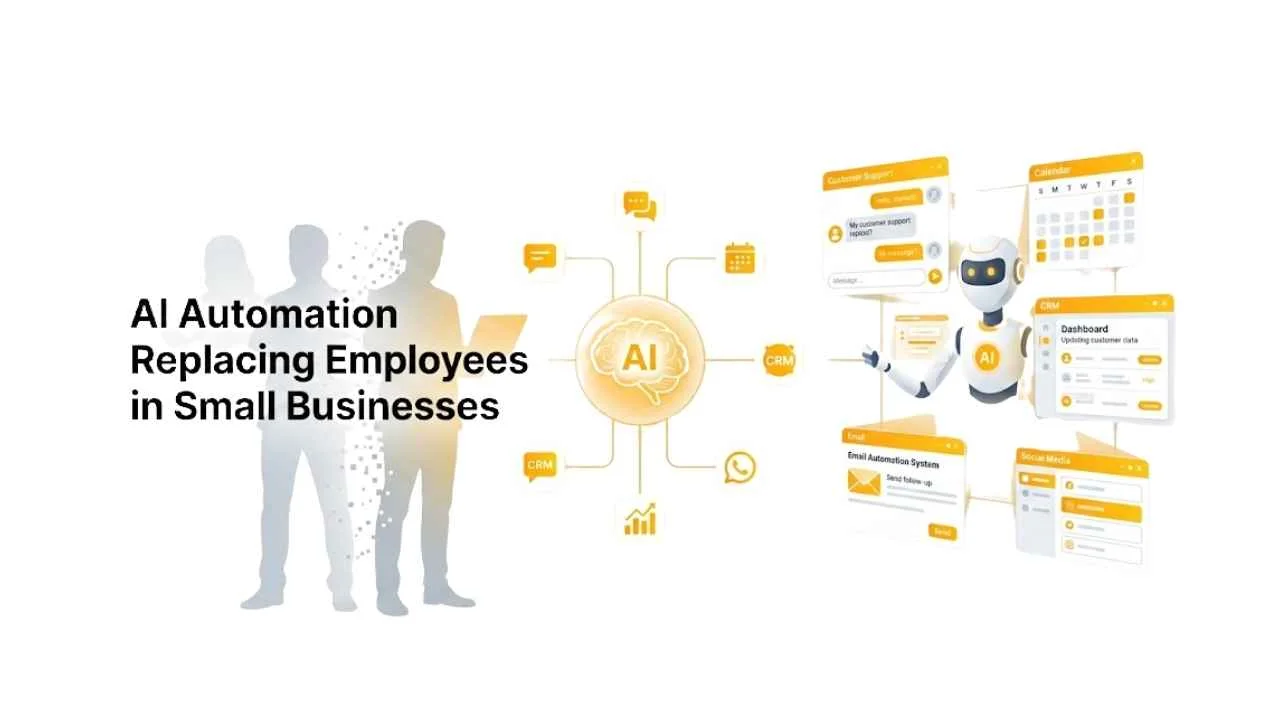
Artificial intelligence (AI) automation of small businesses is the use of artificial intelligence applications to deal with repetitive work, optimizing work processes, and enhancing efficiency without necessarily adding new employees.
Simply put, AI can be seen as an online worker. It has the ability to respond to customer inquiries, book appointments, dispatch follow-up emails, sort data, and even generate reports, just like a staff member; however, it operates 24/7, takes no breaks, and makes fewer errors at the manual level. This automation has 3 major components:
AI agents are intelligent computer assistants that are used to automate certain tasks. As an illustration, an AI customer care agent is able to answer questions immediately on an FAQ list, whereas an AI sales agent can screen a lead and schedule an appointment. They obey regulations, study through observations, and evolve.
Automation of the workflow links activities in a process. AI can automatically cause actions to be performed instead of manually transferring data between systems. For example: By a new lead filling a form, AI welcomes a new lead by email, organizes a call, updates CRM, and informs the sales team.
Examples of tools that are used to connect apps include n8n and Make.com. They are digital connectors, which means that your email system, CRM, web, and payment tools can communicate automatically.
The small businesses are automating some of their roles with AI, not because they want to cut down on human beings, but because they require efficiency, cost fee and scale to be able to survive in an already competitive market.
Salaries, benefits, training, and turnover costs are rising. To most small businesses, finding 2-3 administrative staff may end up burning a huge percentage of their monthly income. Automation of AI enables a company to deal with monotonous duties without increasing the wage bill.
Some of the activities that many employees take hours to accomplish include:
These are also significant, but do not need any creativity or tactical planning. They can be done much quicker and without error by AI systems.
Employees are human beings, and they work fixed hours. AI systems are available around the clock. Inquiries by customers at midnight? Automatic response. On Sunday submitted the lead form? Instant follow-up. This enhances customer experience without raising the personnel expenses.
The sales, marketing, finance, and operations can be integrated into a single seamless system through the use of modern tools that operate on AI workflow automation. Rather than being handed over, the tasks are passed automatically between stages.
Training and recruitment of new employees is time-consuming when there is a business demand. The automation of AI expands on demand. The system can take the load regardless of the number of customers you have, be it 10 or 1,000.
Many business owners now see AI agents as digital team members. They assist human staff rather than fully replace them. Employees can then focus on high-value tasks like strategy, client relationships, and growth planning.
AI automation cannot work to negate strategic leadership or creative decision-making. It is, however, effective when dealing with repetitive and rule-based jobs that eat time and operational budgets. The following business roles clearly demonstrate how AI automation for small businesses creates cost savings and productivity gains.
A significant number of small enterprises end up employing support personnel whose main responsibility is to respond to recurring questions and deal with simple inquiries. The current AI-driven chatbots that integrate with CRM systems and WhatsApp Business can now respond to:
Once the customer types a message in a website chat or WhatsApp, the AI chatbot replies in real-time, retrieves the information in the CRM, and adds it to the chat history automatically. Ticket automation also reduces workload. If a query is complex, the system automatically creates a support ticket, assigns it to the appropriate department, and notifies the team. This ensures faster resolution while reducing the need for multiple full-time representatives.
Sales assistants are known to spend hours qualifying leads and making follow-ups by hand. AI automation can now:
AI lead qualification helps to sift through serious individuals and low-intention inquiries. The system focuses on high-value leads and develops the others using automated follow-ups instead of a human calling every lead. This enhances faster response and avoids lost chances and dependence on various sales coordinators.
One of the best-replaced jobs in small businesses is manual data entry. AI systems can automatically:
Automated data syncing removes human error, whereby information is copied and pasted to eliminate errors. Financial summaries, sales dashboards, and operational analytics can be generated automatically due to report generation tools. This enables the owners of businesses to get real-time insights without necessarily employing specific administrative personnel.
Scheduling calls, consultations, or meetings can consume significant administrative time. AI scheduling agents now:
Instead of back-and-forth emails, customers book appointments directly through intelligent systems. This reduces missed appointments and eliminates the need for a dedicated booking coordinator.
Although even high-level content strategy demands human creativity, AI is capable of executing simple social media tasks, including:
AI posting tools ensure consistent activity across platforms, while automated DM handling manages basic engagement. This reduces the need for entry-level social media staff focused on routine tasks.
Small business AI automation is not a trend only; it has already changed day-to-day operations in various industries. The following are real-life cases of companies that eliminated 2-3 redundant positions by implementing intelligent automation.
Previously an employee in a small home maintenance company:
Having already applied the automation of AI to small businesses, they offered:
At this point, a customer sends a message: Inquiry → AI chatbot replies to inquiry. Automatically scheduled appointment → Confirmation + reminder sent → CRM updated automatically.
Result: They minimized three full-time positions and enhanced speed of response as well as decreased lost bookings.
An agency with a small number of clients had:
Under the AI automation of small businesses, they establish:
Website leads are now automatically captured, rated, nurtured, and booked to sales calls. There is no manual collection of data in generating weekly client reports.
Result: Two functional positions were done away with and the sales process was made quicker and more uniform.
One of the online stores that were used in the past was:
Once small businesses have been automated with AI:
Result: The amount of workload in support was reduced by more than 60 per cent, and manual data entry was also eliminated.
The shift toward AI automation for small businesses is largely driven by cost control. A direct comparison with human staff highlights a significant financial advantage.
| Factor | Human Staff (Pakistan Avg) | AI Automation (Avg) |
|---|---|---|
| Monthly Cost | PKR 40,000 – 80,000 per employee | PKR 15,000 – 50,000 total |
| Working Hours | 8–9 hours/day | 24/7 |
| Accuracy | Medium (human error possible) | High (rule-based precision) |
| Scalability | Requires hiring & training | Instant scaling |
In Pakistan, the average monthly salary for operational roles such as:
If a small business hires just three employees at a conservative average of PKR 50,000 each, that equals:
PKR 150,000 per month = PKR 1.8 million per year
This does not include bonuses, office space, equipment, internet, utilities, or training costs. In comparison, AI automation systems may cost between PKR 15,000 – 50,000 per month, depending on tools and scale, significantly lower than three full-time salaries.
In countries like the US, UK, or UAE:
Replacing just two roles globally could mean annual payroll costs exceeding $70,000–$100,000. AI automation subscriptions, by contrast, often range from $200–$800 per month depending on complexity.
If a business replaces three operational roles in Pakistan:
The financial advantage becomes even larger in international markets. This is why many small businesses are adopting automation — not to eliminate people, but to reduce operational expenses while improving efficiency and scalability.
The very idea of AI automation of small businesses is no longer a dream of the future, but a viable way to save operational expenses, maximize efficiency, and grow fast. Although the concept can be viewed as convoluted, the process can be divided into simple steps that one can actually follow.
The initial phase of adopting AI automation of small businesses is to know what is happening in your processes. Soft Consultants collaborate with the business owners to review the business operations and establish repetitive tasks, bottlenecks, and other areas that are not adding value to the business but consuming time. An adequate process analysis is a way to follow to implement AI agents in areas where they will have the greatest impact.
After determining the tasks, it comes up with a workflow. It will entail the process of mapping each stage of a process, determining decision points, and finding the points at which AI agents or automation tools may intervene. When workflow is properly designed, it will guarantee a smooth operation system, with automated work and minimized human involvement in repetitive work.
The center of AI automation of small businesses is AI agents. These digital workers have a set of rules that are carried out independently. AI agents will be able to handle customer support, filter sales leads, automate follow-up emails, produce reports, or even schedule appointments, depending on the nature of the business requirement.
Integration platforms like n8n and Make.com also integrate various business applications. Working as a CRM, email marketing tool, e-commerce site, and database can communicate automatically through these platforms. As an example, a new customer request received through a form on the website can be followed by automatic processing: welcome email, CRM update, selling agent assigned to the lead, follow-up task scheduled, and so forth, without human intervention.
Prior to going live, workflows and AI agents are tested to make sure they are reliable, accurate, and efficient. Testing helps in making sure that automation tools are compatible with the existing systems and provide the desired cost and time savings.
Automation is not a single arrangement. Companies have to check performance, collect information, and optimize work processes constantly. This guarantees that AI automation for small businesses is developed as per increased demands, changes in customer behaviour, and operational expansion.
Implementing AI automation for small businesses requires the right set of tools to streamline processes, reduce manual work, and increase operational efficiency. Choosing the correct platforms ensures that repetitive tasks, customer interactions, and workflows are managed seamlessly.
n8n is a powerful workflow automation tool that connects multiple apps and services. It allows small businesses to automate complex processes without coding, from data transfers to task triggers. With n8n, repetitive work like lead routing, email notifications, and CRM updates can be handled automatically.
Make.com is another versatile platform for creating automated workflows. Businesses can design custom automation sequences that integrate multiple apps, ensuring smooth task handoffs and minimal manual intervention. Make.com is ideal for small businesses looking to scale without increasing staff.
The OpenAI API provides intelligent AI agents capable of natural language processing. It can power chatbots, customer support, content creation, and lead qualification. By integrating the OpenAI API, businesses can enhance their AI workflow automation with conversational AI that mimics human interactions.
Customer Relationship Management (CRM) tools like Salesforce or HubSpot centralize customer data and allow AI automation to track leads, schedule follow-ups, and generate reports. Integrating CRM systems with AI agents ensures that no lead is missed and customer interactions remain consistent.
The WhatsApp API enables automated messaging for customer support, notifications, and marketing campaigns. Small businesses can respond instantly to inquiries, send updates, and engage customers 24/7, improving satisfaction and reducing manual workloads.
Zapier is a popular automation tool for connecting apps with simple triggers. While highly user-friendly, it has limitations for complex workflows compared to n8n or Make.com. Small businesses can choose between Zapier for simplicity or more advanced tools for full-scale automation.
By leveraging these tools, small business owners can implement AI automation, reduce repetitive tasks, and focus human resources on high-value activities. With proper setup, these platforms collectively enhance efficiency, accuracy, and scalability.
AI automation for small businesses is transforming operations by automating repetitive tasks, streamlining workflows, and improving accuracy. Tools like n8n, Make.com, OpenAI API, CRM systems, WhatsApp API, and Zapier make it possible to scale efficiently and reduce costs. The ROI is clear — businesses save on salaries, reduce errors, and allow staff to focus on high-value work.
With expert guidance from Tech Soft Consultants, small business owners can implement AI smoothly and start seeing measurable results immediately. Explore our comprehensive AI solutions to get started with your digital transformation journey today.
Start saving time, cut costs, and scale your small business intelligently today.
Get Your AI Automation Strategy